

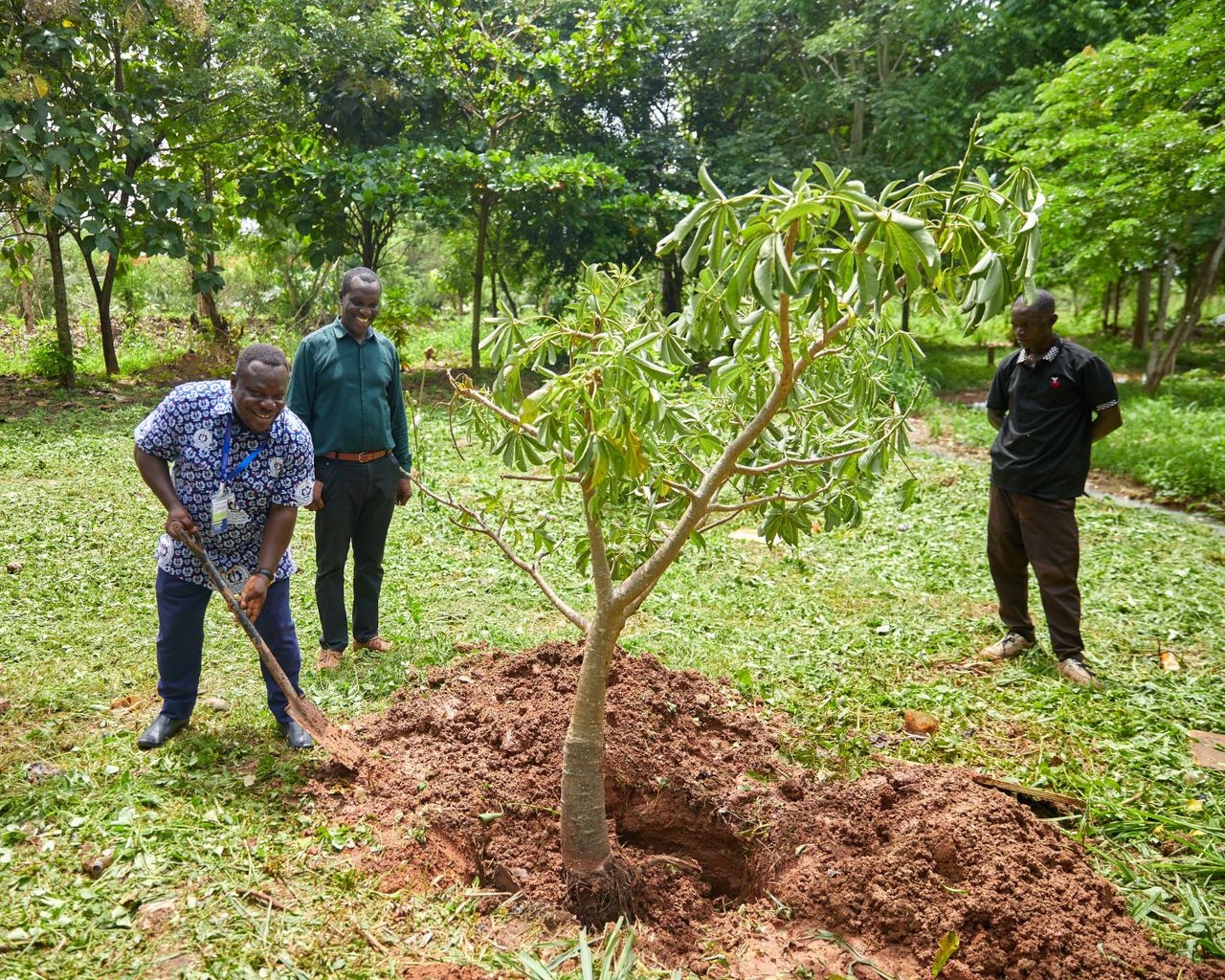
Ho Technical University (HTU) has showcased a breakthrough in applied agricultural research at the 4th Applied Research Conference of Technical Universities of Ghana (ARCTUG 2026) through the development and demonstration of a fast-maturing baobab plant with enhanced growth characteristics.
The innovation, which reflects ongoing research into improved indigenous plant varieties, highlights a scientifically enhanced baobab species capable of reaching maturity within approximately three years, in contrast to the traditional variety, which takes several years.
The breakthrough further serves as a practical illustration of the progress made over the past decade since the conversion of polytechnics into technical universities in Ghana, demonstrating how the institutions have evolved into centres of applied research, innovation, and industry-driven solutions.

Ho Technical University and Takoradi Technical University, led respectively by Vice-Chancellors Prof. Ben Q. Honyenuga and Rev. Prof. John Frank Eshun, continue to advance this mandate by promoting research outputs that directly address national development challenges through science, technology, and innovation.
As part of the conference activities and to commemorate ten years of the conversion of polytechnics into technical universities in Ghana, HTU donated and planted the fast-maturing baobab tree at the gardens of Takoradi Technical University (TTU) during a short ceremony held on Thursday, 28th May 2026.
The donation was received on behalf of Takoradi Technical University by Mr. Kwaku Negble, Deputy Director of Works and Physical Development.

Presenting the plant, Prof. Kenneth Fafa Egbadzor, Director of the Directorate of Research and Innovation at HTU and leader of the HTU delegation to ARCTUG 2026, explained that the improved baobab variety demonstrates the potential of research-driven agricultural transformation. Prof. Egbadzor was assisted during the presentation and planting ceremony by Prof. Charles Atombo and Mr. Jonathan J. Tuokumah.
He noted that beyond its accelerated maturity, the baobab plant possesses immense value, with nearly every part serving a functional purpose in food, health, and industry.

Prof. Egbadzor emphasized sustainability and institutional collaboration, urging TTU to nurture the plant to ensure its long-term benefits and continued symbolic value between the two institutions.
“We expect that as we donate this tree to you, you will take good care of it so that anytime we come here as Ho Technical University, we can pluck some of the fruits and have a taste of it,” he stated.
Mr. Jonathan J. Tuokumah, an exhibitor from Ho Technical University, further reinforced the scientific and industrial importance of the baobab plant, describing it as a multi-use biological resource with significant economic potential.

“The baobab has numerous benefits, with almost every part of the plant being useful—from the roots to the stem, bark, leaves, seeds, and fruits. The fruit pulp can be processed into beverages, ice cream, and jam, while oil extracted from the seeds is useful for food, cosmetics, and pharmaceutical applications,” he explained.
ARCTUG 2026, hosted by Takoradi Technical University, brought together policymakers, researchers, industry leaders, academics, and development partners under the theme: “Advancing TVET for Innovation, Technology Transfer, and Entrepreneurship for Sustainable Development.”
His Excellency, President John Dramani Mahama, opened the conference on Tuesday, 26th May 2026.
